
Student Loan Sharks #6

Using student loans for tuition, books and living expenses. Beware!

You are probably wondering why I am using the word “beware” when most students routinely use their student loans for tuition, books and living expenses. It’s pretty common, however, that extra $2,000 to $4,000 above the tuition easily slips through your hands for worthless things that you will regret later. Especially when you begin to realize the interest you are paying on that amount will capitalize causing the unpaid interest ($600) to double ($1,200) in one month, thereby increasing the total amount you owe (principal balance). It’s all because you had to have Starbucks every day, bought trendy clothing and shoes, and other things you really didn’t need as much as you thought.

I don’t know about you, but I have regretted taking the maximum loan amount for a few semesters while I was unemployed. I wish I would have done more that I did, especially knowing what I know now. As a matter of fact, I am about to make an extremely bold statement regarding my regret. Here it is…

I wish I would not have gone to college in my late forties. I also wished I would have done a little more research on how interest accrues and capitalization costs. Furthermore, the availability of scholarships and grants are almost non existent for single, white, females who are young seniors. I regret just “signing my name”.

Okay, I said it and I’m glad I got that off my chest. Looking back, I could have kicked myself for trading my future for the slavery of debt and for the rest of my life! Now you’re probably thinking that was a little harsh, but it is my reality and it will be yours too unless you wake up before it’s too late! My reality is that I will be paying my student loan debt well into my “golden years”. Yes, I mean retirement years! This just burns me and it is not a pretty sight!

The U.S. Department of Education makes it easy to obtain a loan and colleges are willing to sign up anyone with a pulse–or so it seems. Just signing your name didn’t require all the work I had to do to continue to make ends meet while unemployed. I felt like the rabbit while they had the perfect, orange carrot dangling on a string enticing me with only one little signature. Yes, I take full responsibility for signing something I didn’t really understand (capitalization) but I thought an education would make my life better. Add to that the stress of trying to find a job because I knew my situation couldn’t last much longer–I was on borrowed time. Do you see yourself in a similar situation and need some advice?

Here are some helpful tips for those who are struggling to stay afloat while in school OR are now repaying your student loan debt.

  • Tuition debt only. If at all possible, only take out loans for tuition.
  • Rent your books. This is the most cost effective way to significantly reduce your school expenses. Especially when you consider that after the semester is over the same book will only be worth half the amount you paid for it.
  • Financial Aid. Go and see the Financial Aid counselor and tell him/her that you will have to drop out of school unless you receive a scholarship or grant. It’s amazing how they seem to find other resources for you.
  • Visit the Foundation Office. Many students don’t even know that they offer scholarships based on need. (The money goes quickly, so get the details before the semester ends and the new one begins.)
  • Apply for grants and scholarships online. There is “free” money out there but it takes time and persistence. (Find the Stars Scholarship Fund for your state.)
  • For those really desperate situations. Sell some of your personal possessions, clothing and shoes. You’ll be surprised how much this can help. (I’ve used Facebook yard sale and Craig’s list.)
  • Rent out one of your rooms. If you live in a house this will really help. If you live in an apartment, inquire about adding a roommate to your lease.
  • Consider another side hustle. Many students and adults are supplementing their income with side hustles like Uber and Lyft or a part-time job.
  • Make interest only payments on your school loan debt. This is not the optimal situation, but at least the interest charged per month is not doubling. When interested capitalizes each month, you are paying interest on top of interest which increases your principal balance.

I hope this list helps and be sure to stop by for more student loan shark information you need to know!

Student Loan Sharks! #4

Today’s Topic: Income Driven Repayment Plans, Congress and Student Loan Rates, Call For Action!

Most graduates are shocked when they get that call telling them it’s time to begin paying their student loans and how much they “have to pay” for their student loans. Many can’t pay the required amount so they enroll in an Income Income Driven Repayment Plan. Yes, it does help while you look for a better paying job, but it comes with a cost.

  • “Negative Amoritization” – Under most income driven repayment plans the monthly payment does not cover the interest fees per month let along apply anything to principal. This is where borrowers get into trouble because their loan balance is increasing every month regardless of the payments received and it is due to negative amoritization.

ALERT! Did you know that Capitalization occurs when…

“You Voluntarily Leave” – If you voluntarily leave the Revised Pay as You Earn, Pay as You Earn (PAYE) or Income-Based Repayment (IBR) plans (learn more about income-driven repayment);

“You Fail To Annually Recertify” – If you fail to annually update your income for some of the income-driven plans (learn about recertifying your income); or

“You No Longer Qualify” – If you are repaying your loans under the PAYE or IBR plans and no longer qualify to make payments based on income.

NOTE: Loans in default are not eligible for any income based repayment or income-driven repayment plans. Find out how to get out of default.

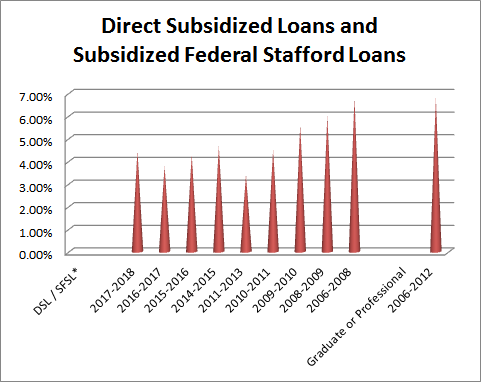
  • “Congress & Student Loan Interest Rates” – Congress sets student loan rates every year based on the 10-year Treasury Note. Take a look at the interest rates, especially during the height of the recession from 2006 – 2010 and the Graduate degree interest rates.

Congress needs to find a relief valve for student loan borrowers. I’m not talking about forgiveness of loans (because that’s when the IRS steps in and now you’ve got a tax problem). Under former student loan plans borrowers were sent 1099’s because of loan forgiveness programs. What a shock that would be!

According to Market Watch’s, January 7, 2019 article 44 million Americans are struggling with $1.5 trillion in student debt. Now you understand why current and former students are stuck when it comes to buying a house, car, planning for retirement or looking to change jobs. After rent, utilities, car payments, daycare and medical expenses, there just isn’t anything left. For those trying to plan for retirement it’s even worse.

  • “Call For Action” – With 44 million Americans struggling, we are a strong voice. Tell Congress to lower interest rates and change all loans to simple interest loans so students can actually pay off their loans. With the current way student loans capitalize, it makes it almost impossible to pay them off!

Contact your local Congressman/woman and tell him/her that we need relief now!

*Photo courtesy of MediaSalon.com

Student Loan Sharks! #3

Today’s Topic: Targeting Payments, Payment Directive and the Debt Snowball.

  • “Targeting Payments” – Targeting Payments is the best way, I believe, to pay off your loans faster. With targeting payments, you have choices in how payments are applied. You can apply payments directly to one loan or have your payment spread out among all your loans–it’s up to you. This is easily done by making an online payment. Here’s how:
  1. Go to Account Summary, select Make A Payment.
  2. Select Target Specific Loans and enter an amount on one loan or divide the payment among all your loans.
  3. You cannot pay student loans on weekends or holidays and it takes 2-3 days to process your payment so pay before the due date.

Remember, if you pay more than the total amount due and don’t target your payment, your loan servicer will apply the extra amount toward a future bill (assuming you have one), unless you qualify for a $0.00 payment with Income-Driven Repayment. The extra amount is spread across your loans based on the amount due for each loan.

  • “Payment Directive” – However, if you want to have all of your future extra funds applied in the same way, you can write to Fed Loan Servicing and provide standing instructions (i.e. payment directive) by Mail, Fax or Email. For an example of the payment directive sample letter, go to Consumer Finance Protection Bureau’s sample letter(DOC).
  • “Debt Snowball” – Recently, I was thinking about a Dave Ramsey course I took in the past and Dave recommends the debt snowball. Basically it involves paying off the smallest loans first and applying/stacking that payment onto another payment you are already making to pay it off faster. I was trying to tackle the largest ones first and it seemed overwhelming! Here are Dave Ramsey’s Debt Snowball strategies:

Step 1: “List your debts from smallest to largest.”

Step 2: “Make minimum payments on all debts except the smallest—throwing as much money as you can at that one. Once that debt is gone, take its payment and apply it to the next smallest debt while continuing to make minimum payments on the rest.”

Step 3: “Repeat this method as you plow your way through debt. The more you pay off, the more your freed-up money grows—like a snowball rolling downhill.”

I hope you have learned something new about your student loan debt and just think, you didn’t have to pay an arm and a leg for it! Stay tuned for more topics on student loan debt.

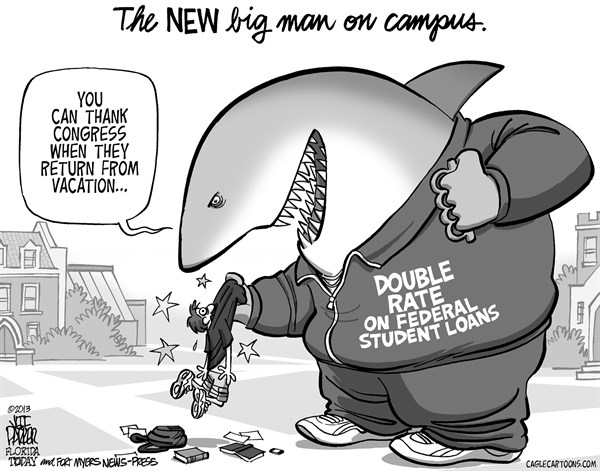
*Picture courtesy of Florida Today and Fort Myers News Press.

Student Loan Sharks! #2

Today’s Topics: Future Payments, Paying Ahead, Interest and Capitalization.

Today there is a lot to discuss and with this information you can develop a strategy for how you are going to pay off your student loan debt or at the very least, know what to expect.

I called the Customer Service number again, but this time I asked how is my monthly payment applied to my loan? And, what if I wanted to pay more than the monthly payment–how is that applied? I was shocked at what I heard and you will be too!

“All” extra monies paid above your regular payment are applied to FUTURE PAYMENTS! I was dumbstruck!!! Just as fast as the first Ninja Warrior kick came, he jumped in the air and spun around to deliver a deadly blow that left me dazed and confused. I couldn’t believe what I heard.

Let me break down the different scenarios you have probably already experienced and wondered why your balance hardly changed.

  • “Future Payments” – If my monthly payment is $600 and I paid $700, the extra $100 goes toward “future payments”. You probably expected to see a $100 reduction in the principal amount, but that is not how your payments are processed. The extra $100 goes to any outstanding interest first, then principal–UNLESS you have a payment directive on file (covered in volume 3).
  • “Paying Ahead” – If my monthly payment is $600 and I paid $1,200 you believe you have paid ahead 1 month. Right? Wrong. Using the same principle above your “extra payment” of $600 goes toward interest first, then “future payment”–UNLESS you have a payment directive on file. **Paying ahead may also negatively affects IDR/IBR plans.
  • “Paying Ahead & My Payment Decreased” – If my April monthly payment is $600 and I paid $1,200, my June payment will show a “$0” payment. You’re all excited thinking you’ve been given a reprieve, but not so fast. Interest continues to accrue the day after your payment even though it shows a “$0” payment. You must continue to pay interest or it will capitalize (double).
  • “Interest” – Your loans accrue interest every day. Remember, student loans are not simple interest loans! Ask your loan servicer how much you pay in interest “per day”, then do the math. Example $12.50 daily interest x 31 days = $387.50 per month x 12 months = $4,650 a year. This amount increases if you miss just 1 payment or pay late.
  • “Capitalization” – Ever wondered why your balance is increasing and/or interest is doubling? It’s because of capitalization. Capitalized interest increases the total balance of your loan amount. How? It’s unpaid interest that is added to your student loan balance when you are in forbearance, deferment or just don’t make payments. Because of “capitalization” you’ll repay much more than you originally borrowed.
  • “Capitalization Example” – You borrow $80,000 with a loan rate of 6%. After four years in deferment (you made no payments on your unsubsidized loan while in school) your interest of $21,600 is now added to the principal balance of your loan after your grace period ends and repayment begins. Now instead of owing $80,000, you owe $101,600. To make matters worse, you will be paying “interest on top of the interest of your loan!” The same principal applies if you miss a payment.
  • “No Payment OR Payment Doesn’t Cover Interest” – If you fail to make a payment during the next scheduled payment, or the payment made does not cover the interest, that is when the accrued interest would capitalize and be added to the principal balance of the loan.

The confusing part for the borrower is that they think they have paid ahead when in reality it’s like the payment was sucked into the black abyss and you’ve got nothing to show for it. Furthermore, you still have to pay the next month’s payment too (you know the one that you thought you already paid) or your interest will double. You cannot afford to miss one payment!

Don’t even think about forbearance or deferring your loans either, because once the interest capitalization train begins to roll it will quickly get out of control and then you’ve got a train wreck on your hands. Basically, once you get off of deferment or forbearance, your first few months or more of payments will be applied to the interest that you have accrued and “none will be applied toward principal” until you have paid off all the interest owed first.

When most people think of interest, they think of a simple interest loan where you can pay ahead and your interest is fixed each month. To help you really know how to tackle your student loan debt, ask your student loan servicer for an amoritization schedule for your plan. You may also find an amoritization calculator online, but you need to make sure it uses capitalization versus simple interest.

There was a lot of information covered in this post, however, don’t despair as good news is on the horizon. Volume 3 will be coming out shortly–stay tuned!

*Photo courtesy of Dave Granlund.com

Student Loan Sharks!

*A Must Read for Anyone with Student Loan Debt. Volume 1

Student loan debt is an issue near and dear to my heart. Why? Because I have a large amount of debt accumulated in my Master’s Degree program. Yes, I knew the amount I was financing each semester but I thought I would be able to work hard and pay it off in a few years. Unfortunately, my dream turned into a nightmare!

My first smack in the face came when my new monthly payment was calculated at a whopping $1,000 per month. I was shocked! I called customer service and told them that I needed money to live too or else I would become homeless. I was told that they don’t take into account rent, utilities or existing bills. This is your new payment–like it or not.

I fully anticipated paying off my student loans methodically by paying a little extra principal each month. (You know, like you do for your monthly mortgage to reduce the number of years.) This new amount, however, blew that plan out of the water. Then I asked how much of that payment is going toward principal versus interest? The customer service agent said about $150 spread out over 12 different loans. A quick math calculation in my head make the situation even worse. I was only paying about $12.50 per loan towards the principal amount. I realized that I would never be able to repay these loans off despite how much I sacrificed. As fast as a ninja warrior could kick, I was hit again. With that kick, came the sudden realization that my monthly interest payment was about $800 each month and I would carry these loans well into my retirement years!

I was angry and depressed about my future. All the joy I anticipated knowing that my Master’s Degree would allow me to earn more money went right out the window. Don’t they know it takes more than six months to transition from a lower level position to a higher one? Especially when the current company you are with offers no room for advancement let alone a raise for your educational attainment.

What could I do? My answer came through lots of research online and asking a lot of questions. Look for Student Loan Sharks – Volume 2.

*Picture courtesy of Florida Today and Fort Myers News Press.