Cubans Still Arriving In Florida Keys!

Since my last article entitled “Too Late For Cubans“, another group made a daring attempt to cross the ocean in a makeshift styrofoam and wood pallet boat. The Cuban migrants set sail March 30, 2019 and arrived in the Florida Keys on April 1st. Unfortunately the April Fools day arrival was on them as they didn’t even make it on shore. They were spotted at sea by a couple who called in a “suspicious vessel” report to the Coast Guard. In the meantime, the couple gave the migrants water and oranges until the Coast Guard arrived and took them into custody where they were returned to Cuba.

On March 20, 2019 another group of seven Cubans arrived in Key Largo. This group’s arrival was filmed by Keys locals who greeted them with hugs as they documented the end of their journey at sea. These men were also returned to Cuba.

Cuban migrants arrival filmed in Florida Keys by Locals.
Photos courtesy of McClatchy

It doesn’t make sense to me that Cubans still continue to risk their lives by crossing the sea when the “wet foot/dry foot” policy was ended by former President Obama. I wish I had been there to interview the Cuban migrants, because there has to be other reasons for fleeing Cuba than the ones we already know. I would love to tell their story!

Student Loan Sharks #5

Today’s Topic: Student Loan Debt Relief Scams, Bankruptcy, Student Loan Forgiveness Numbers, Exposing Scam Companies and Social Media Giants That Aid Them!

Almost every day I receive calls from student loan companies offering me immediate debt relief, loan forgiveness and interventions that will force loan servicers to reduce my debt. Sounds great right? Wrong! These companies are scammers who lure struggling borrowers with promises that are outright lies. Is Your Company On Nerd Wallet’s Watch List? Be sure to check the link below to see if your student loan company is scamming you!

  • Tip #1 – How to Quickly Identify Student Loan Scams
    • Charge upfront fees
    • Promise to have your loans eliminated
    • Promise immediate loan forgiveness
    • Pressure you to sign up
    • Ask you sign a power of attorney to make decisions for you
    • You are asked to share sensitive, personal information
    • Portray themselves as the Department of Education
    • The company advertises on social media or pops up in search engine ads
  • Tip #2 – Do you know that not even Bankruptcy will cancel student loan debt!

Unlike other consumer debt such as credit card and mortgage debt, student loans traditionally cannot be discharged in bankruptcy. The occasional exception is the Brunner Test regarding financial hardship.

According to Forbes 2019, “Student loan debt is now the second highest consumer debt category – behind only mortgage debt – and higher than both credit cards and auto loans.” Take a look at Forbes’ statistics:

  • Total U.S. Borrowers With Student Loan Debt: 44.7 million
  • Student Loan Delinquency Or Default Rate: 11.4% (90+ days delinquent)
  • Direct Loans – Cumulative in Default (360+ days delinquent):$101.4 billion (5.1 million borrowers)
  • Direct Loan In Forbearance: $111.1 billion (2.6 million borrowers)
  • Public Service Loan Forgiveness Statistics
    • Number of applications approved: 423
    • Number of applications denied: 32,409
    • Borrowers who have received student loan forgiveness: 206

Two things pop out when I review the statistics–the default rate and the measly number of individuals who actually received student loan forgiveness!

  • Tip #3 – Student Loan Scamming Companies

Now the information you’ve been waiting for regarding student loan scammers. Thanks to the reporting done by Nerd Wallet, you can access a list of student loan debt companies who are scamming borrowers. In fact, former student loan servicer now whistleblower, Bob Greenberg exposes some of the tactics he learned as a manager at Consumer Assistance Project LLC in Coral Gables, Florida. He was trained to tell borrowers anything to keep them on board. Why? Because he earned commissions for everyone he signed up and told them whatever they wanted to hear. He also told borrowers to pay them versus their federal loans and members paid up to $303 per month to Consumer Assistance. The company’s social media ads boasted “Over 5 Million Students Already Forgiven. You’re Next!” and more Facebook ads like “Get Rid Of Your Student Loans Once And For All!” One interesting note is that many of the workers at Consumer Assistance also worked for law firms.

He knew something wasn’t right when each day, Greenberg says, managers gave call-center workers a new, untraceable 800 number for prospective customers to call.

Meanwhile companies like Consumer Assistance Project LLC and others promising debt relief to financially distressed student loan borrowers are siphoning millions of dollars from them with fees for services that never materialize. The student loan industy is ripe for scammers as loans soar to nearly $1.4 trillion according to a NerdWallet investigation. This scam reminds me of the foreclosure defense cases that exploded a few years ago with similar claims.

What is worse for borrowers is to realize that they could have helped themselves for “free” online versus paying a phony debt relief company. To add insult to injury, the borrower believes they are receiving help when what they’ve really done is give permission to the company to scam them. These companies change the borrower’s passwords and then let the account lapse while continuing to auto debit the borrower each month. Then Uncle Sam steps in and begins to garnish wages, seize tax refunds and ruin people’s lives and credit. One woman I met said that Uncle Sam had seized the family home after her mother (borrower) died. Yes, Uncle Sam put liens on the family home then forced the sale to collect on the liens. The daughter is still homeless today. How many other students and their families will end up homeless before something changes?

Thankfully NerdWallet is warning consumers by creating a Student Loan Watch List which has flagged more than 130 businesses who were investigated, sued or penalized and so much more. When you consider Consumer Assistance Project LLC had more than 400 customers who were charged at least $250 a month with gross revenues of about $1.2 million a year, you begin to understand why scammers have chosen the student loan industry. Check out Nerd Wallet’s Watch List here.

Tip #4 – Social Media Companies Let The Scam Continue: The U.S. Consumer Financial Protection Bureau is trying to get big online companies like Google, Facebook, Yahoo and Bing to block advertising by these scam student debt relief companies. Two years after letters were sent to Google, Facebook, Yahoo and Bing, the ads are still allowed to be displayed. What’s interesting is that predatory lenders a/k/a payday loans are being blocked more than student loan scam ads which are much more egregious in my opinion, especially when restitution reveals just how large fraud is in this industry.

Social media responses, “Yahoo had no details on steps taken to block such ads. A spokesman for Microsoft, Bing’s owner, declined to comment. Google and Facebook did not respond to interview requests” according to NerdWallet.

Step #4 – Let Your Voice Be Heard! Tell Google, Facebook, Microsoft and Bing that by not blocking these ads they are colluding with these scam artists in committing crimes against student loan borrowers and their families. It must be stopped!

Don’t forget to call/write Congress and tell them to “wake up” and start working on a solution to the problem before it spirals out of control! Can you imagine if everyone defaulted? What a mess that would be. As I have said before, “capitalization” of interest is the primary reason why student loan debt is spiraling out of control thereby causing more students to default!

*Picture courtesy of Frumforum.com

Kingdom Truths: False Predictions of Christ’s Return

Today’s Topic: Don’t Be Deceived!

You’ve heard it on the radio or seen it on TV as individuals, scientists and even preachers have tried to predict the date that Jesus Christ will return for his people a/k/a The Rapture. One Chinese man even built his version of Noah’s Ark out of fear of survival for him and his family (picture above). But I’m sure many are wondering why someone would put themselves on national television warning the masses to “get ready”. I wholeheartedly believe in sharing the “Good News of Jesus Christ”, however, you have to wonder how these men were deceived yet were so fervent in their claims. To make matters worse, they damaged the credibility and cause of Christ. Don’t be “deceived”! Scripture says,

However, no one knows the day or hour when these things will happen, not even the angels in heaven or the Son himself. Only the Father knows.”

Mark 13:32

Predicting the date of Jesus Christ’s return has been going on for centuries. Today’s society, however, seems even more jaded about religion and doesn’t believe there is a God, just like the days of Noah. Let’s take a look at some of the historical predictions noted below.

  • Johannes Stöffler, a well respected German mathematician and astrologer, predicted that a great flood would cover the world on February 25, 1524. Hundreds of pamphlets were distributed causing general panic. Count von Iggleheim, a German nobleman, went so far as to build a three-story ark.
  • Edgar Whisenant, a Former NASA engineer, wrote a book in the late 80’s called “88 Reasons Why the Rapture Will Be in 1988” and he sold millions of copies.
  • Hal Lindsey who wrote the bestselling book “The Late Great Planet Earth”, predicting Jesus would come in 1988.
  • Michael Drosnin, author of “The Bible Code”, claimed scripture word search revealed a date for World War III in the year 2000.
  • Harold Camping, radio evangelist, publicly predicted the end of the world 12 times. Most notable was his book pronouncing September 4th or 6th, 1994 as the end of the world. Then he predicted May 21, 2011, which was exactly 7,000 years after the Biblical flood. Later he claimed October 21, 2011 claiming that his math was off.
  • Mayan Calendar doomsday predictions that marked the end of civilization on December 21, 2012 with giant solar flares, massive tidal catastrophes, earth colliding with an imaginary planet and a realignment of the Earth’s axis.
  • Lu Zheng , a Chinese man built a modern-day Noah’s ark to prepare for the 2012 end of the world flood. His preparations began in 2010 out of fear for the survival of him and his family. (picture above)

These events remind me of other scripture verses which tells us of false prophets performing great signs and wonders to deceive many.

Then if anyone says to you, ‘Look, here is the Christ!’ or ‘There!’ do not believe it.   24 For false christs and false prophets will rise and show great signs and wonders to deceive, if possible, even the elect. 25 See, I have told you beforehand. 26 “Therefore if they say to you, ‘Look, He is in the desert!’ do not go out; or ‘Look, He is in the inner rooms!’ do not believe it.”

Matthew 24:23-26 (NKJV)

In many churches today, it is unfortunate that believers are hearing “good stories” of things that have happened in someone’s life or a “paraphrased” version of scripture which is the author’s interpretation of the message versus reading the Biblical Word of God.

Don’t Let Yourself Be Deceived. As Christians, we need to stop relying on what the preacher or men say and actually open our Bibles and read it daily. Take the time to search the scriptures every day like the Bereans. See if what is being taught in your church is the true Word of God! (Acts 17:11) Do their words line up with the infallible Word of God? If not, find a Bible believing church who does.


Paulas, Rick (2014) on Vice.com. “What Happened to Doomsday Prophet Harold Camping.”

Cole, Rachael on Britannica.com. “10 Failed Doomsday Predictions.”

BibleBrisket.com. “Notable Failed Predictions for the End of the World.”

Huffington Post (2012). “Lu Zhenghai, Chinese Man, Builds ‘Noah’s Ark’ In Preparation For 2012 Mayan Apocalypse” and picture.

Student Loan Sharks! #4

Today’s Topic: Income Driven Repayment Plans, Congress and Student Loan Rates, Call For Action!

Most graduates are shocked when they get that call telling them it’s time to begin paying their student loans and how much they “have to pay” for their student loans. Many can’t pay the required amount so they enroll in an Income Income Driven Repayment Plan. Yes, it does help while you look for a better paying job, but it comes with a cost.

  • “Negative Amoritization” – Under most income driven repayment plans the monthly payment does not cover the interest fees per month let along apply anything to principal. This is where borrowers get into trouble because their loan balance is increasing every month regardless of the payments received and it is due to negative amoritization.

ALERT! Did you know that Capitalization occurs when…

“You Voluntarily Leave” – If you voluntarily leave the Revised Pay as You Earn, Pay as You Earn (PAYE) or Income-Based Repayment (IBR) plans (learn more about income-driven repayment);

“You Fail To Annually Recertify” – If you fail to annually update your income for some of the income-driven plans (learn about recertifying your income); or

“You No Longer Qualify” – If you are repaying your loans under the PAYE or IBR plans and no longer qualify to make payments based on income.

NOTE: Loans in default are not eligible for any income based repayment or income-driven repayment plans. Find out how to get out of default.

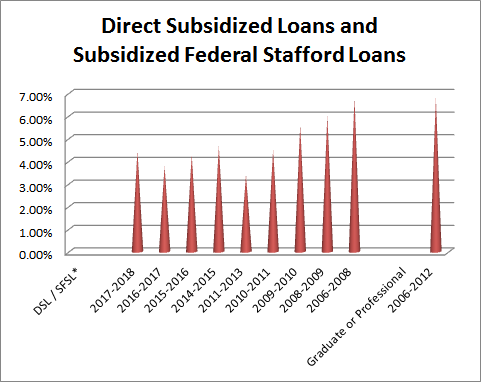
  • “Congress & Student Loan Interest Rates” – Congress sets student loan rates every year based on the 10-year Treasury Note. Take a look at the interest rates, especially during the height of the recession from 2006 – 2010 and the Graduate degree interest rates.

Congress needs to find a relief valve for student loan borrowers. I’m not talking about forgiveness of loans (because that’s when the IRS steps in and now you’ve got a tax problem). Under former student loan plans borrowers were sent 1099’s because of loan forgiveness programs. What a shock that would be!

According to Market Watch’s, January 7, 2019 article 44 million Americans are struggling with $1.5 trillion in student debt. Now you understand why current and former students are stuck when it comes to buying a house, car, planning for retirement or looking to change jobs. After rent, utilities, car payments, daycare and medical expenses, there just isn’t anything left. For those trying to plan for retirement it’s even worse.

  • “Call For Action” – With 44 million Americans struggling, we are a strong voice. Tell Congress to lower interest rates and change all loans to simple interest loans so students can actually pay off their loans. With the current way student loans capitalize, it makes it almost impossible to pay them off!

Contact your local Congressman/woman and tell him/her that we need relief now!

*Photo courtesy of MediaSalon.com

Student Loan Sharks! #3

Today’s Topic: Targeting Payments, Payment Directive and the Debt Snowball.

  • “Targeting Payments” – Targeting Payments is the best way, I believe, to pay off your loans faster. With targeting payments, you have choices in how payments are applied. You can apply payments directly to one loan or have your payment spread out among all your loans–it’s up to you. This is easily done by making an online payment. Here’s how:
  1. Go to Account Summary, select Make A Payment.
  2. Select Target Specific Loans and enter an amount on one loan or divide the payment among all your loans.
  3. You cannot pay student loans on weekends or holidays and it takes 2-3 days to process your payment so pay before the due date.

Remember, if you pay more than the total amount due and don’t target your payment, your loan servicer will apply the extra amount toward a future bill (assuming you have one), unless you qualify for a $0.00 payment with Income-Driven Repayment. The extra amount is spread across your loans based on the amount due for each loan.

  • “Payment Directive” – However, if you want to have all of your future extra funds applied in the same way, you can write to Fed Loan Servicing and provide standing instructions (i.e. payment directive) by Mail, Fax or Email. For an example of the payment directive sample letter, go to Consumer Finance Protection Bureau’s sample letter(DOC).
  • “Debt Snowball” – Recently, I was thinking about a Dave Ramsey course I took in the past and Dave recommends the debt snowball. Basically it involves paying off the smallest loans first and applying/stacking that payment onto another payment you are already making to pay it off faster. I was trying to tackle the largest ones first and it seemed overwhelming! Here are Dave Ramsey’s Debt Snowball strategies:

Step 1: “List your debts from smallest to largest.”

Step 2: “Make minimum payments on all debts except the smallest—throwing as much money as you can at that one. Once that debt is gone, take its payment and apply it to the next smallest debt while continuing to make minimum payments on the rest.”

Step 3: “Repeat this method as you plow your way through debt. The more you pay off, the more your freed-up money grows—like a snowball rolling downhill.”

I hope you have learned something new about your student loan debt and just think, you didn’t have to pay an arm and a leg for it! Stay tuned for more topics on student loan debt.

*Picture courtesy of Florida Today and Fort Myers News Press.

Student Loan Sharks! #2

Today’s Topics: Future Payments, Paying Ahead, Interest and Capitalization.

Today there is a lot to discuss and with this information you can develop a strategy for how you are going to pay off your student loan debt or at the very least, know what to expect.

I called the Customer Service number again, but this time I asked how is my monthly payment applied to my loan? And, what if I wanted to pay more than the monthly payment–how is that applied? I was shocked at what I heard and you will be too!

“All” extra monies paid above your regular payment are applied to FUTURE PAYMENTS! I was dumbstruck!!! Just as fast as the first Ninja Warrior kick came, he jumped in the air and spun around to deliver a deadly blow that left me dazed and confused. I couldn’t believe what I heard.

Let me break down the different scenarios you have probably already experienced and wondered why your balance hardly changed.

  • “Future Payments” – If my monthly payment is $600 and I paid $700, the extra $100 goes toward “future payments”. You probably expected to see a $100 reduction in the principal amount, but that is not how your payments are processed. The extra $100 goes to any outstanding interest first, then principal–UNLESS you have a payment directive on file (covered in volume 3).
  • “Paying Ahead” – If my monthly payment is $600 and I paid $1,200 you believe you have paid ahead 1 month. Right? Wrong. Using the same principle above your “extra payment” of $600 goes toward interest first, then “future payment”–UNLESS you have a payment directive on file. **Paying ahead may also negatively affects IDR/IBR plans.
  • “Paying Ahead & My Payment Decreased” – If my April monthly payment is $600 and I paid $1,200, my June payment will show a “$0” payment. You’re all excited thinking you’ve been given a reprieve, but not so fast. Interest continues to accrue the day after your payment even though it shows a “$0” payment. You must continue to pay interest or it will capitalize (double).
  • “Interest” – Your loans accrue interest every day. Remember, student loans are not simple interest loans! Ask your loan servicer how much you pay in interest “per day”, then do the math. Example $12.50 daily interest x 31 days = $387.50 per month x 12 months = $4,650 a year. This amount increases if you miss just 1 payment or pay late.
  • “Capitalization” – Ever wondered why your balance is increasing and/or interest is doubling? It’s because of capitalization. Capitalized interest increases the total balance of your loan amount. How? It’s unpaid interest that is added to your student loan balance when you are in forbearance, deferment or just don’t make payments. Because of “capitalization” you’ll repay much more than you originally borrowed.
  • “Capitalization Example” – You borrow $80,000 with a loan rate of 6%. After four years in deferment (you made no payments on your unsubsidized loan while in school) your interest of $21,600 is now added to the principal balance of your loan after your grace period ends and repayment begins. Now instead of owing $80,000, you owe $101,600. To make matters worse, you will be paying “interest on top of the interest of your loan!” The same principal applies if you miss a payment.
  • “No Payment OR Payment Doesn’t Cover Interest” – If you fail to make a payment during the next scheduled payment, or the payment made does not cover the interest, that is when the accrued interest would capitalize and be added to the principal balance of the loan.

The confusing part for the borrower is that they think they have paid ahead when in reality it’s like the payment was sucked into the black abyss and you’ve got nothing to show for it. Furthermore, you still have to pay the next month’s payment too (you know the one that you thought you already paid) or your interest will double. You cannot afford to miss one payment!

Don’t even think about forbearance or deferring your loans either, because once the interest capitalization train begins to roll it will quickly get out of control and then you’ve got a train wreck on your hands. Basically, once you get off of deferment or forbearance, your first few months or more of payments will be applied to the interest that you have accrued and “none will be applied toward principal” until you have paid off all the interest owed first.

When most people think of interest, they think of a simple interest loan where you can pay ahead and your interest is fixed each month. To help you really know how to tackle your student loan debt, ask your student loan servicer for an amoritization schedule for your plan. You may also find an amoritization calculator online, but you need to make sure it uses capitalization versus simple interest.

There was a lot of information covered in this post, however, don’t despair as good news is on the horizon. Volume 3 will be coming out shortly–stay tuned!

*Photo courtesy of Dave Granlund.com

Student Loan Sharks!

*A Must Read for Anyone with Student Loan Debt. Volume 1

Student loan debt is an issue near and dear to my heart. Why? Because I have a large amount of debt accumulated in my Master’s Degree program. Yes, I knew the amount I was financing each semester but I thought I would be able to work hard and pay it off in a few years. Unfortunately, my dream turned into a nightmare!

My first smack in the face came when my new monthly payment was calculated at a whopping $1,000 per month. I was shocked! I called customer service and told them that I needed money to live too or else I would become homeless. I was told that they don’t take into account rent, utilities or existing bills. This is your new payment–like it or not.

I fully anticipated paying off my student loans methodically by paying a little extra principal each month. (You know, like you do for your monthly mortgage to reduce the number of years.) This new amount, however, blew that plan out of the water. Then I asked how much of that payment is going toward principal versus interest? The customer service agent said about $150 spread out over 12 different loans. A quick math calculation in my head make the situation even worse. I was only paying about $12.50 per loan towards the principal amount. I realized that I would never be able to repay these loans off despite how much I sacrificed. As fast as a ninja warrior could kick, I was hit again. With that kick, came the sudden realization that my monthly interest payment was about $800 each month and I would carry these loans well into my retirement years!

I was angry and depressed about my future. All the joy I anticipated knowing that my Master’s Degree would allow me to earn more money went right out the window. Don’t they know it takes more than six months to transition from a lower level position to a higher one? Especially when the current company you are with offers no room for advancement let alone a raise for your educational attainment.

What could I do? My answer came through lots of research online and asking a lot of questions. Look for Student Loan Sharks – Volume 2.

*Picture courtesy of Florida Today and Fort Myers News Press.

Is Your Sunscreen Toxic?

For me, going to the beach is about relaxing, putting my feet in the water, reading a magazine and letting go of the stresses of the day. One day after slathering on my favorite suntan lotion, my skin began to really itch and it just kept getting worse. It had only been an hour and even taking a shower did not reduce the constant itching. I tried using cortizone cream and that only helped a little–I was miserable! This event caused me to take a look at the ingredients that are in my favorite suntan lotion that might be the culprit. Well, I was certainly surprised and I know you will be too with what I’m about to share.

Sunscreens have active two ingredients that are mineral or chemical filters or contain both. The most common sunscreens contain chemical filters that are actively used today. Sunscreen ingredients can include two to six of the following active ingredients: oxybenzone, avobenzone, octisalate, octocrylene, homosalate and octinoxate. Mineral sunscreens use zinc oxide and/or titanium dioxide. A handful of products combine zinc oxide with chemical filters.

I found that my dermatologist said it is fairly common for people to have sunscreen-related skin allergies due to the chemicals and especially fragrances found in sunscreens, cosmetics and everyday products. What I didn’t know is that some sunscreens penetrate through the skin down to your organs and can have effects on your hormones, thyroid and even men’s testosterone levels. Does your sunscreen contain any of these ingredients? Have you had any of these symptoms/results? EWG tested these chemicals and here are the results.

^Oxybenzone – a hormone disrupting chemical with high rates of skin allergies.
^Methylisothiazolinone – detected in nearly every American; 1-9% skin penetration; weak estrogen, associated with altered birth weight in human studies, a skin allergen and now allowed in leave-on products in Europe.
^Octinoxate (Octylmethoxycinnamate) – skin penetration with moderate rates of skin allergies.
^Homosalate – skin penetration, disrupts estrogen, androgen and progesterone.
^Octisalate – skin penetration, but with rarely reported skin allergies.
^Octocrylene – skin penetration with relatively high rates of skin allergies.

According to EWG, existing data of the nine most commonly used suncscreen chemicals shows great concern over oxybenzone. Oxybenzone, was added to nearly 65 percent of the non-mineral sunscreens in EWG’s 2018 sunscreen database. Oxybenzone can cause allergic skin reactions (Rodriguez 2006). In laboratory studies it is a weak estrogen and has potent anti-androgenic effects (Krause 2012, Ghazipura 2017). The Centers for Disease Control and Prevention routinely detects oxybenzone in more than 96 percent of the American population.

When looking for sunscreen try to find lotions that are free from dyes, fragrance, masking fragrance (covers any offensive odors that naturally occur in a product), lanolin, parabens, formaldehyde (can you believe it!) and other preservatives.

Look up or scan the bar code of your favorite sunscreen to see if it is toxic with EWG’s app. You’ll be surprised at what your learn! The website address is: https://www.ewg.org/sunscreen/

Wondering who is EWG? “EWG is a nonprofit, non-partisan organization dedicated to protecting human health and the environment. The Environmental Working Group’s mission is to empower people to live healthier lives in a healthier environment. With breakthrough research and education, we drive consumer choice and civic action.”

“EWG’s groundbreaking research has changed the debate over environmental health. From households to Capitol Hill, EWG’s team of scientists, policy experts, lawyers, communication experts and programmers has worked tirelessly to make sure someone is standing up for public health when government and industry won’t. Through our reports, online databases, mobile apps and communications campaigns, EWG is educating and empowering consumers to make safer and more informed decisions about the products they buy and the companies they support. In response to consumer pressure, companies are giving up potentially dangerous chemical ingredients in their products and improving their practices.”

America: A Nation of Cheaters?

Cheating is rampant in America. What’s the solution?

Before you get excited about the headline, I realize you can not dump everyone into one basket by making such a broad statement about America as a whole.  Hopefully you were just as disgusted as me when reading today’s news headlines about the elite, wealthy, and actresses spending $25M in bribes to put their sons and/or daughters into Ivy League schools.  These are students who would not qualify based on their own merits.

Myself and millions of other college students had to work hard to get into college and did not have rich parents who could ensure admission into Ivy League schools with little to no effort on their part.  Now we all know that cheating is not new and it has probably been going on for years across the county, but thankfully someone exposed the cheaters.  So far, there have been 33 parents involved in buying their students entrance exams, test scores, answers or just plain bribe hush money as reported by the FBI.  I was surprised to learn that many of the students were not involved or had no knowledge of their parent’s plan to cheat or put together creative financial deals.

Since cheating is a nationwide issue, you have to wonder how many students across the nation could not get into college as a result of cheating?  A look at the past reveals the most shocking educational cheating that has been going on for some time by the Business Insider and Ranker.

  • 2018 – The NCAA stripped the University of Louisville’s men’s basketball team of its 2013 national championship title over a recruiting scandal, where coaches used sex workers to entice recruits and keep players happy at the university.
  • 2012 – Harvard cheating scandal involved approximately 125 Harvard University students.
  • 2011 – Largest teacher cheating scandal in the country’s history happened in Atlanta with 178 teachers and administrators implicated in cheating on competency tests.
  • 2004-2010 – Over 700 Texas schools suspected of cheating and even hundreds more with suspicious test scores.
  • 1999-2001 – Thirty-two schools and 52 teachers and administrators implicated in New York City  investigation of teacher cheating.
  • 1993-2011 – The University of North Carolina helped 3,100 students get good grades with little work for 18 years! Hundreds of classes required little work or had no faculty involvement and many of the students involved were student-athletes.
  • 1989-1991 – The University of Miami was placed on probation for forging Pell Grant applications worth approximately $220,000 in funds.

More than 80 percent of college students claimed they have cheated in some way while in school according to a 2017 Cleveland.com survey.

From politicians to business leaders to colleges and students, cheating is rampant in our society. 

What can we do? We should demand transparency in the admission selection process of all colleges and universities so that potential students and parents know what to expect.   Finally, students who have worked hard deserve an opportunity to attend Ivy League schools despite their social status. 

A Sign from…

*Photo courtesy of South Florida Sun Sentinel

On February 5, 2019, a very, very, large wooden cross washed ashore on Ft. Lauderdale Beach to the delight of beach-goers.  It was 20 foot long, barnacle encrusted and looked like it could have been made from railroad ties.

According to the South Florida Sun Sentinel, Mary Ann Smolinski, visiting from Michigan said, “It’s amazing. Very spiritual.”  Not long after the tales about how the cross washed ashore and the possibility of its spiritual meaning were heard everywhere.  Some say it was probably from Puerto Rico due to last year’s hurricanes while others believe it is a spiritual sign.  One man was so moved by the cross as a sign that he called his friend and said he was going back to church.

Today the cross now lays behind the Ocean Manor Beach Resort where it took ten men and two ATV’s to pull it ashore.  WSVN reported “Ocean Manor resort Owner Frank Talerico told WSVN he had goosebumps when he learned of the cross and believed it was a sign of protection. He said his sister had been praying at the property that morning after having a bad dream.”

Have you received a sign?  What was it?  Remember, it is what you do with the sign that matters!   So stay alert, read the Word, and pray!