
Today’s Topic: Targeting Payments, Payment Directive and the Debt Snowball.
- “Targeting Payments” – Targeting Payments is the best way, I believe, to pay off your loans faster. With targeting payments, you have choices in how payments are applied. You can apply payments directly to one loan or have your payment spread out among all your loans–it’s up to you. This is easily done by making an online payment. Here’s how:
- Go to Account Summary, select Make A Payment.
- Select Target Specific Loans and enter an amount on one loan or divide the payment among all your loans.
- You cannot pay student loans on weekends or holidays and it takes 2-3 days to process your payment so pay before the due date.
Remember, if you pay more than the total amount due and don’t target your payment, your loan servicer will apply the extra amount toward a future bill (assuming you have one), unless you qualify for a $0.00 payment with Income-Driven Repayment. The extra amount is spread across your loans based on the amount due for each loan.
- “Payment Directive” – However, if you want to have all of your future extra funds applied in the same way, you can write to Fed Loan Servicing and provide standing instructions (i.e. payment directive) by Mail, Fax or Email. For an example of the payment directive sample letter, go to Consumer Finance Protection Bureau’s sample letter(DOC).
- “Debt Snowball” – Recently, I was thinking about a Dave Ramsey course I took in the past and Dave recommends the debt snowball. Basically it involves paying off the smallest loans first and applying/stacking that payment onto another payment you are already making to pay it off faster. I was trying to tackle the largest ones first and it seemed overwhelming! Here are Dave Ramsey’s Debt Snowball strategies:
Step 1: “List your debts from smallest to largest.”
Step 2: “Make minimum payments on all debts except the smallest—throwing as much money as you can at that one. Once that debt is gone, take its payment and apply it to the next smallest debt while continuing to make minimum payments on the rest.”
Step 3: “Repeat this method as you plow your way through debt. The more you pay off, the more your freed-up money grows—like a snowball rolling downhill.”
I hope you have learned something new about your student loan debt and just think, you didn’t have to pay an arm and a leg for it! Stay tuned for more topics on student loan debt.
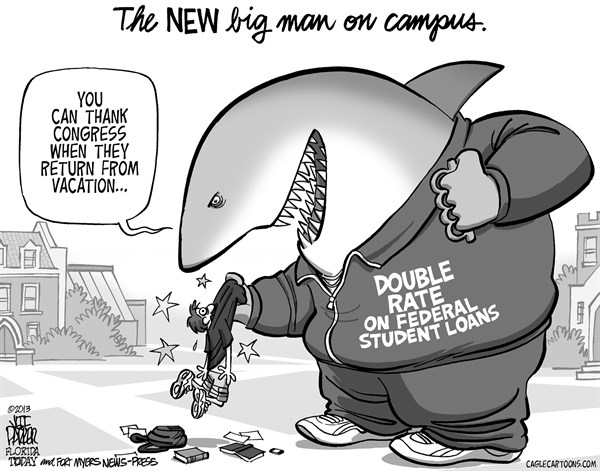
*Picture courtesy of Florida Today and Fort Myers News Press.




 Get The WORD Out!